Showing posts with label Sculpture. Show all posts

Wednesday, July 15, 2026

MMFA 2026: Torlonia Collection - Roman Sculpture

THE TORLONIA COLLECTION
MASTERPIECES OF ROMAN SCULPTURE

Montreal Museum of Fine Arts
March 14 – July 19, 2026

The Montreal Museum of Fine Arts (MMFA) was honoured to host The Torlonia Collection: Masterpieces of Roman Sculpture. The final stop on a historic North American tour, this major exhibition brought together 57 lifelike marble sculptures: Roman statues, busts, and sarcophagi; stunning bas-reliefs; mythological creatures; and striking portraits of gods and goddesses, emperors, and their wives. These masterpieces have been shown in Canada for the first time.

The Largest Private Collection of Ancient Roman Marble Sculptures The Torlonia Collection is one of the most important ensembles of ancient Roman sculptures still in existence. Assembled in the 19th century by the Torlonia family, most notably by prince and banker Alessandro Torlonia (1800–1884), who founded the Museo Torlonia in 1876, the collection rivals the Vatican and Capitoline museums in both quality and scope.


A true "collection of collections," it was built thanks to excavations on former imperial estates and through a series of acquisitions of major holdings. It comprises 623 marble works (and a single bronze work) representing Roman sculpture from the Republic through the Empire periods. For much of the past century, access to these works has been limited: they were known primarily through 19th-century publications. After spending decades out of public view, the sculptures have now been restored and are finally being presented in all their splendour.


Alessandro Poma Murialdo, President of Fondazione Torlonia, stated:

"Fondazione Torlonia is excited to be sharing the Torlonia Collection with audiences in Canada for the first time. This exceptional group of ancient sculptures is a testament to the enduring cultural legacy of ancient Rome, as well as the vision and passion of multiple generations of the Torlonia family." 

Carlotta Loverini Botta, Director of Fondazione Torlonia elaborated:

"Fondazione Torlonia is delighted to present in Canada this important ensemble, which covers three centuries of collecting ancient masterpieces. This exhibition reflects not only the history of the artworks themselves, but also the legacies of their many owners: the centuries-old Roman aristocracy, acclaimed restorers, and visionary collectors. It exemplifies the ‘contemporary act' of a long-standing principle underpinning the Torlonia Family's practice of artistic patronage—for through art, people find their destinies to be intertwined, shaping not only what we see, but also who we become." 


Laura Vigo, Curator of Asian art and Archeology at the MMFA and responsible for the exhibition's Montreal presentation, added: 

"Assembled by a lineage of princes, the Torlonia Collection offers a rare opportunity to experience the sensory power these ancient marble sculptures still radiate today. Visitors will have the chance to meet the gaze of Roman emperors such as Marcus Aurelius, Hadrian, and Commodus, and to encounter Hercules, Bacchus, or Cupid as they walk among some of the most celebrated statues of Antiquity." 


This landmark exhibition brings together nearly 60 ancient marbles of breathtaking realism: Roman statues, busts and sarcophagi, bas-reliefs of stunning beauty, mythological creatures, and striking portraits of gods and goddesses, emperors and their consorts. These masterworks are being presented in Canada for the first time.

The Torlonia Collection stands as one of the most important ensembles of ancient Roman sculpture in existence. Assembled by the Torlonia family in the 19th century, most notably by prince and banker Alessandro Torlonia (1800-1884), who established the Museo Torlonia in 1876, the collection rivals the Vatican and Capitoline Museums in both quality and scope. 


The final stop of a historic North American tour, The Torlonia Collection is still on view at the Montreal Museum of Fine Arts (MMFA) until July 19, 2026. This exhibition is an exceptional window into the artistic genius of ancient Rome.

All photos @Nadia Slejskova

Click on any image for photo gallery.  


Visit the Montreal Museum of Fine Arts website for more information and to purchase your tickets online.

This article's dedicated internet website address.


Wednesday, June 03, 2026

PAC 2026: Heroes of Greece. The Age of Troy


HEROES OF GREECE - THE AGE OF TROY
  

June 4, 2026 - March 7, 2027


Pointe-à-Callière, the Montréal’s archaeology and history complex, had announced the opening of the new exhibition Heroes of  Greece. The Age of Troy. Guided by the Iliad, the legendary epic featuring heroes and powerful gods and goddesses, this major exhibition explores the origin and legacy of this seminal work attributed to the poet Homer. At the crossroads of myth and reality, the exhibition immerses visitors in history, showcasing nearly 400 authentic objects—treasures of Greece—from 28 Greek museums and archaeological sites. Several works are being presented on display for the first time in North America. 


The exhibition presents some of the greatest historical and literary adventures: the Trojan War, Homer’s heroes and the gods of Olympus—a heroic saga of human passions and divine conflicts. It offers a unique opportunity to delve into the origins of the myth and discover the secrets behind this epic that has shaped the Greek imagination and left its influence on the Western world and many civilizations throughout the centuries. It unveils unique pieces that give visitors a chance to explore a fascinating narrative and follow the paths of its protagonists. These pieces also shed light on the historical and cultural contexts in which these writings were relayed and disseminated. 


 Anne Élisabeth Thibault, Executive Director of Pointe-à-Callière, stated:

"It is always a great source of pride to host a large-scale international exhibition at Pointe-à-Callière. Seeing these objects brought together in one place is an exceptional event, made possible through a collaboration with the Ministry of Culture of the Hellenic Republic (Greece) and several museums. Beyond their beauty, these objects embody the enduring legacy of Homeric myth, inviting visitors to encounter Achilles, Odysseus, and Helen. It is fascinating to see how these narratives, over 3,000 years old, remain relevant today and how their heroes continue to move us. Rarely has Greece agreed to lend a heritage collection of such magnitude to a museum in North America, making this exhibition a major cultural happening and an exceptional museum event." 


A Journey Between Myth and Historical Reality

To begin, the exhibition opens by introducing the visitors to the great figures of the Iliad: Helen, Paris, Agamemnon, Achilles, Ajax, Hector, and other protagonists whose epic journeys is revealed throughout the exhibition.

The visit then leads to an exploration of the poet Homer—an enigmatic figure if ever there was one—to whom this work is attributed. Opinions are divided: Was Homer the sole author? Did he really exist? The exhibition reveals the era in which he is believed to have lived: the Iron Age (c. 1100–800 BCE), a period marked by social upheaval and the emergence of ironwork. Authentic amphorae, oinochoai, lekythoi, skyphos (all distinct types of ancient Greek pottery, weapons, and statuettes bear witness to this pivotal period in Greek history, from which Homer introduces elements in the Iliad.


The journey continues on Mount Olympus, home of the gods and goddesses, where we meet the true instigators of the Trojan War. They directly intervene in the fate of mortals, supporting or opposing the heroes. Zeus, Hera, Athena, Aphrodite, Apollo, and Poseidon reveal their central role through impressive statues and artifacts!


Leaving the exhibition’s ground floor and ascending to the first floor, the visitors will step back in time, nearly 400 years before Homer’s era, the period that inspired the Iliad and during which the Trojan War is believed to have taken place. The exhibit delves into the heart of the rich and powerful Mycenaean civilization of the Bronze Age (1600–1200 BCE). Reflecting a time of great prosperity, the objects on display illustrate the exceptional know-how of Mycenaean artisans of that period, as well as their way of life: gold ornaments, exquisite jewelry, weapons, and figurines.


Towards the end, the exhibition takes the visitors to the heart of major episodes of the conflict that took place in Troy, from its origin to the fall of the city, all revealed through original illustrations and exceptional artifacts.


 A Greek-Canadian Mission to Argilos

Located in northern Greece, Argilos is one of the oldest Greek colonies. Since 1992, the Canadian Institute in Greece—which is celebrating its 50th anniversary this year—has been conducting a Greek-Canadian archaeological mission at the site. The Argilos site has revealed the remains of a prosperous city, with shops, residential areas, and infrastructure that bear witness to its economic vitality. Several artifacts discovered at Argilos are featured in the exhibition.


Complementing the exhibition this summer

GUIDED TOURS

The Museum offers guided tours during which visitors can explore the exhibition and ask questions:

  • Guided tours (20 min.) / every day (schedules at the reception counter)

  • Visitor’s booklet for families 

LECTURES

  • The Archaeology of Mycenaean, Bronze Age, and Iron Age Civilizations, with Jacques Y. Perreault, Professor in the Faculty of Arts and Sciences — Department of History and Director of the Canadian Institute in Greece / Thursday, June 4, 2026 at 7 pm

The lecture series will continue with a rich program in the fall of 2026.

EVENT

The summer Apéro-Expo event will offer a unique opportunity to visit the exhibition in a friendly and festive atmosphere with a DJ, access to the Museum’s rooftop terrace, and flavours of the Greek islands.

  • Apéro-Expo / Thursday, July 9, 2026, from 6:30 pm to 10:30 pm

CULTURAL ACTIVITIES

On Sundays during the summer, enjoy free Heroic Greece themed activities for the whole family. Activities include myths and legends, drawing, dancing, and music!

  • Family Sundays: July 12, 19, and 26 and August 16 and 23, 2026, from 1 pm to 4 pm

See the complete program on Pointe-à-Callière’s website : www.pacmusee.qc.ca 


Acknowledgements

The exhibition Heroes of Greece. The Age of Troy is a joint production of Pointe-à-Callière, Montréal’s archaeology and history complex, and the Ministry of Culture of the Hellenic Republic (Greece). In partnership with Desjardins – Caisse du Centre-Ville-de-Montréal, Air Canada Cargo, YUL – Montréal-Trudeau International Airport, Tourisme Montréal, St-Sulpice Hotel, and La Presse. The Museum sincerely thanks its lenders, sponsors, and partners.


All photos in this article @ Nadia Slejskova

This article's dedicated internet address. 


About Pointe-à-Callière, Montréal Archaeology and History Complex

Inaugurated in 1992, on the city’s 350th anniversary, Pointe-à-Callière is today the largest archaeology museum in Canada and the busiest history museum in Montréal. Rising above a concentrated number of historic and archaeological sites of national significance—including the birthplace of Montréal, the Museum has a mission to preserve its collections and to further knowledge, while showcasing and fostering an appreciation for Montréal’s archaeological and historical heritage. This mission is carried out through various activities focused on conservation, research, presentation, education, and inclusion, along with community initiatives benefiting both Montrealers and visitors to the city. Pointe-à-Callière is a partner of the City of Montréal.


Thursday, January 30, 2025

Musée des Hospitalières 2025: Jana Sterbak

CORPUS INSOLITE: JANA STERBAK

Musée des Hospitalières de l’Hôtel-Dieu de Montréal

29 January 2025 - 24 August 2025

The Musée des Hospitalières de l’Hôtel-Dieu de Montréal, renowned for its unique collections of historical, medical and religious artifacts, presents a new exhibition, Corpus Insolite: Jana Sterbak.This exhibition invites visitors to experience Sterbak’s thought-provoking works in dialogue with the museum’s collections.

Jana Sterbak is a globally acclaimed, Montreal-based artist. She explores in her works the themes of power and desire, often incorporating unconventional materials. Her works explore the themes of mortality, transcendence, and transformation, which in this exhibition are brought into dialog with the medical and religious artifacts from the museum's collection.

For this exhibition, Jana Sterbak and curator Johanne Sloan worked closely together to integrate Sterbak’s artworks into the museum’s exhibition spaces, while also selecting objects to be brought out of storage for the first time. 


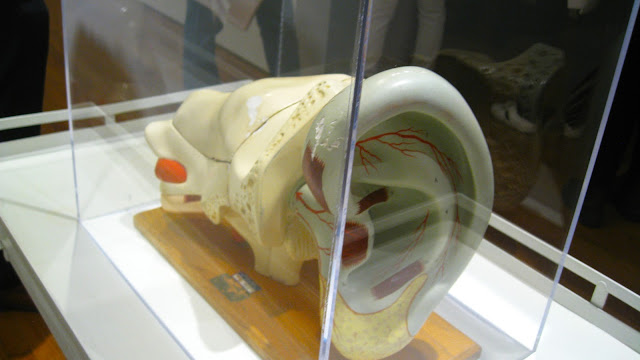
For example, Sterbak’s internationally recognized Vanitas: Flesh Dress for an Albino Anorectic, (the so-called meat dress), which was first shown in 1987, has been re-made for this exhibition, and is displayed in the proximity of anatomic models and holy relics. This offers a unique opportunity to re-discover the work of Jana Sterbak in dialog with the exhibits from the museum’s collection.


In addition to the two works Sylvanus and Hot Crown, which have never before been shown in Montreal, Jana Sterbak's internationally acclaimed Vanitas: Flesh Dress for an Albino Anorectic, first exhibited in 1987, was remade for this exhibition, contrasted with the museum's anatomical models and sanctified relics. It is a long, white feminine dress with the real male chest-hair woven into it.

The sculpture of a crown which lights brightly every 80 seconds also seems to reflect on both the worldly and spiritual powers.

Also of interest are the skeleton bones displayed under the glass and looking very much like real human skeleton bones, especially in contrast with other bone remain in the same room, are actually made of chocolate. 


The Musée des Hospitalières de l’Hôtel-Dieu de MontréalThis offers a unique opportunity to rediscover the work of Jana Sterbak while, at the same time, discovering the museum's collections through an artistic imagination.

Sterbak's pieces also reflect on the human stages of life, like the closed circle and the spiral-like progression.


The top-most image in this article, curtesy of the the Musée des Hospitalières de l’Hôtel-Dieu de Montréal.

All other photos @Nadia Slejskova

For more information visit the museum's website.


About the Musée des Hospitalières de l’Hôtel-Dieu de Montréal

The mission of  the Musée des Hospitalières de l’Hôtel-Dieu de Montréal is to transmit the history of Montreal and its foundation, to publicize the history of the Hôtel-Dieu de Montréal, to exhibit the tangible and intangible heritage of the Hospitallers of Saint Joseph, and to explore the history of healthcare and the health sciences.

Four centuries of history can be traced through the museum’s unique collection, which is linked to the development of Montreal, to hospital, medical and pharmaceutical practices, and to religious art.

Located within Mount Royal’s protected area, in a special natural setting, the museum is a part of one of the city’s best preserved convent complexes, home to the Hospitallers of Saint Joseph. The ensemble, built in 1861 to plans by the architect Victor Bourgeau, includes the order’s original monastery and garden, the hospital, three chapels, a crypt and the museum itself, housed in the former chaplains’ residence.