Wednesday, August 26, 2015

World Press Photo 15: Montreal 2015


Montreal World Press Photo 15
August 26- September 27, 2015

As in previous years, the Montreal World Press Photo 15 is held at the Bounsecure market (Marché Bonsecours), in Old Montreal. The exhibition presents photos that were awarded a special merit by the World Press Photo jury this year. There are many such photos on display; each visitor is bound to find a favourite one.


Above and just below are two areal photos of the exhibition's display set up. The photos are grouped by various categories like General News, Contemporary Issues, Daily Life, Nature, Portraits and Sports.


The photo below won First Prize General News Category, Singles. It was taken by Sergei IlnitskyRussia, European Pressphoto Agency on August 26, 2014, in the city Donetsk, which lies in the part of Ukraine that seeks independence. Damaged goods lie in a kitchen in downtown Donetsk. Ordinary workers, miners, teachers, pensioners, children, and elderly women and men are in the midst of the conflict in eastern Ukraine. Artillery fire killed three people and wounded. This photo is a modern and tragic version of the classical naturmort paintings' composition that depicts a table with copious foods on it. In case you are unfamiliar with naturmort paintings, google for images to see some examples.


The photo just below, by Massimo SestiniItaly, merited the Second Prize General News Category, Single. It depicts shipwrecked people rescued by a frigate of the Italian navy 20 miles north off the coast of Libya. After hundreds of men, women and children had drowned in 2013 off the coast of Sicily and Malta, the Italian government put its navy to work under a campaign called “Mare Nostrum” rescuing refugees at sea. Only in 2014, 170,081 people were rescued and taken to Italy. It has a clear-cut and simple composition that is very effective. Furthermore, the boat is in a shape of a bullet, with the waves making it look like a bullet flying through the air, and this is what the refuges are fleeing from - from the real life bullets. 


The next photo below truly has a feel of a painting. It must have been photoshopped to give it such a stunning visual and colour effect. It won the Second Prize in the category Long-Term Projects and it is by Kacper Kowalski, Poland. It looks like a wide opened eye of the nature starring at us.


This is what the caption to the Kowalki's photo states:
54°33’47.37”N 18°13’42.22”E. Kacper Kowalski is a pilot and a photographer. Side Effects is a documentary project about the complex relationship between humans and nature. The photos were shot either from a paraglider or a gyroplane, some 150 meters above the ground, mainly in the area around Gdynia, in Poland, where Kowalski lives. In this work, Kowalski explores answers to questions that deeply interest him: What is the natural environment for humans? Is it an untouched, virgin landscape? Or is it a landscape that has changed, adapted to human needs? Kowalski sees his work as offering a graphic and sometimes abstract portrait of how civilization came into being. For Kowalski, the content of the photo is less important than the reactions, reflections, and ideas that arise when looking at it. He would like the project to be a starting point for discussion about what is good or bad, necessary or optional, in the relationship between humans and nature.
The camera is never connected to a remote control, and Kowalski never uses a drone. He wants to be up there, camera in hand. And he flies alone. That means he doesn’t have to explain anything, or rely on another person’s spatial imagination. It means he can fly precisely. Side Effects is more a method of visual storytelling than a concrete set of pictures. It is an ongoing project that will continue to be modified.


The above photo won the Second Prize Nature Category, Singles. It is by Ami Vitale, USA, National Geographic. It was taken in Lewa Downs, Northern Kenya. It has a high artistic interest in regard to repeated patterns and colour highlights. Notice how the semicircle of the hands completes the semicircle of the rhino head to make an elliptical shape which is further enhanced by the semicircle of the grass edge below the animal's head and that of the bracelets above. It is really a great composition. It is not clear though whether the rhino was shot or only tranquillized, or was it trained to lie down and don't move. Even the caption and story do not tell us this.

The caption reads: A group of young Samburu warriors encounter a rhino for the first time in their lives. Most people in Kenya never get the opportunity to see the wildlife that exists literally in their own backyard.

Story: organized by sophisticated, heavily armed criminal networks and fuelled by heavy demand from newly minted millionaires in emerging markets, poaching is devastating the great animals of the African plains. Much needed attention has been focused on the plight of wildlife and the conflict between poachers and increasingly militarized wildlife rangers, but very little has been said about the indigenous communities on the front lines of the poaching wars and the work that is being done to strengthen them. These communities hold the key to saving Africa’s great animals.


The photo above won Second Prize Sports Category, Singles. It is by Al BelloUSA, Getty Images. Odell Beckham (#13) of the New York Giants makes a one-handed touchdown catch in the second quarter against the Dallas Cowboys at MetLife Stadium at East RutherfordNew JerseyUSA. Once again, notice the composition, and not only the feat of actually catching the ball in that impossibly awkward position. Apparently, the fans are still talking about it.

Plan to attend the Montreal's World Press Photo 15. For more information, consult their website here.

Click on images to enlarge them.

Three top photos by Nadia Slejskova.

Five images of photos on display at the Montreal's World Press Photo 15 exhibition courtesy of  World Press Photo.

Thursday, July 30, 2015

MMFA Director Natalie Bondil, Order of Canada

NATHALIE BONDIL
Member of the Order of Canada

It was announced earlier this month that Natalie Bondil, the highly respected Director and Chief Curator of the Montreal Museum of Fine Arts, has received a very prestigious honour for her excellent and monumental work in promoting and benefiting the MMFA, the Montreal's prominent and well liked museum. She was appointed a Member of the Order of Canada for her contribution to the promotion of the arts and culture as a museologist and the museum's administrator. With great energy and many talents, she brought the Montreal Museum of Fine Arts to a new level with many innovations, excellent international contacts and exhibitions, also enlarging and enhancing the museum with new pavilions and new concepts.

Additionally, on May 29, 2015, Natalie Bondil was awarded another honour: she received an honorary doctorate from the Université de Montréal in recognition of her outstanding contribution to the development of the MMFA, the promotion of culture and popular education, and for consolidating the links between the museum and the Université de Montréal.

The official photo of Madame Bonvil just above is very symbolic, with layers of meaning. First of all, she is shown not in the Museum's public area but in the inner space, the "innards" of the institution where her work takes place. On the left, in the background, is the painting by a French painter James Tissot October, 1877. It portrays a beautiful and elegant French woman, symbolic of Natalie Bondil's roots, who is a native of France. On the photo's right are two paintings by a Canadian painter Michael Snow from the series Walking Women, 1963. Canada is the county where Madame Bondil took her most prominent steps. This photo clearly illustrates that Natalie Bondil successfully unites the classical European heritage with modern North American trends, on the bases of which she builds museum's strong and prominent international presence. She further enhances the museum with worldwide art treasures and many international exhibitions and projects. 

I took the two photos below on November 2, 2011. Madame Bondil is on a podium during a press conference. You can read about this event and the MMFA exhibitions at that time here. As I have noted then, there is an uncanny postural likeness as well as facial and body expression in both women, the one in the painting and the real one. To some extent, there is also a similarity as to their dress and shoes, though Madame Bondil's style is very contemporary.


Find more about the Montreal Museum of Fine Arts by visiting the MMFA website.

Friday, July 17, 2015

Park Jean-Drapeau Public Art Audio Guide


Park Jean-Drapeau Sculptures
Audio Guide

The Portrait Sonore organization, in collaboration with the Société du parc Jean-Drapeau, has just released a walking tour-documentary which helps to discover the park's public art in a lively, poetic and musical manner. This is a two hour, a cell phone facilitated stroll, a true “pocket report” with sound and music, that puts one in the midst of the Park Jean-Drapeau to discover 15 public art works spread out on St-Hélène and Notre-Dame islands.


The audio guide presents many eyewitnesses, creators and experts who explain the issues regarding the conservation of the works, the artistic considerations and values that led to their design, and the spirit of the era in which they were created when art became accessible to all.


The Jean-Drapeau park audio guide also features 15 musicians from Québec’s local music scene, each providing their own musical interpretation of an art work. This results is 15 original compositions that hone senses and inject new life into sculptures in a very personal manner. The musical selection was directed by composer Antoine DJ Champion and Diane Labrosse.


Portrait Sonore is an independent non-profit organization whose main mandate is using new technologies to better understand and experience the modern city, its art, and its architecture. Parc Jean-Drapeau/Public Art is part of a broader project on the modernization of the major Canadian cities. This initiative was led by architect Sophie Mankowski with the collaboration of Antoine Bédard and Serge Rhéaume (all three are co-founders of PORTRAIT SONORE).


In 2017, three major anniversaries will be celebrated: the 150th anniversary of Canadian confederation, the 375th anniversary of the City of Montréal, and the 50th anniversary of Expo 67.  PORTRAIT SONORE is making a series of walking tour-documentaries about the history of the modernization of Canadian cities: Québec City, Toronto, Winnipeg, Québec, Vancouver, Halifax and Ottawa. From sea to sea, this project strives to contribute to the emergence of a modern, Pan-Canadian architectural awareness among the general public as it lends more visibility to bold but little-known works of art. It creates a bank of documentation and experts’ and Canadian creators’ accounts that are accessible to everyone. By 2017, all of these projects (and more) will be available and hosted on the PORTRAIT SONORE app, an intuitive application designed by graphic designer Serge Rhéaume.


The project has received support from the Canada Arts Council, the Royal Architectural Institute of Canada, Heritage Canada, the City of Montréal, and Parc Jean-Drapeau. 

Click on any image to enlarge it.

Access Portrait Sonore Parc Jean-Draperau Public Art guide here. At the end of the introduction, click on any sculpture on the map to continue your tour.

This free application will also be shortly available at the Google Apps Store. You can also download the application for iPhone or iPad here.

Access all Portrait Sonor projects here.

Saturday, July 11, 2015

Michelangelo's Sistine Chapel in Montreal


Michelangelo's Sistine Chapel Exhibition

July 10 - October 12, 2015

Montreal holds a premier of a stunning exhibition - the monumental work of the Renaissance artist Michelangelo di Lodovico Buonarroti Simoni (6 March 1475 – 18 February 1564), better known as simply Michelangelo. Several North American cities were in the bid to have the premier of this first ever travelling show of Michelangelo's Sistine Chapel, but it was Montreal that won. In the next 15 years the show will travel all around the world, providing to many people 
a great opportunity to see it. The scaffolding that is used to exhibit the works was made in Montreal. It mimics the scaffolding used when the Sistine Chapel was renovated. It also provides an easy travelling mounting system for this exhibition.


Michelagelo was an Italian sculptor, painter, architect, poet, and engineer who tremendously influenced the development of the western art. During his lifetime, he was considered to be the greatest living artist, and is still considered by many to be the greatest artist of all times. And now, the Montrealers and other visitors from around the world have a unique opportunity to experience in person the grandeur and scope of one of his most magnificent creations, the frescoes of the Sistine Chapel.


The works on display are the life-size reproductions of the original frescoes, created with a special photographic reproduction technique that captured the look, size and the feel of the original frescoes through the use of original licensed photos.


The exhibition is being held at the Montreal's Palais des congres, Espace 1001. The location offers a unique opportunity for visitors to views the works at a perfect distance proportional to their sizes, something that the Sistine Chapel does not offer, although, I am sure, many of us would have liked to also experience the original frescoes in their original setting in Vatican.


The Sistine Chapel's ceiling is 21 meters hight, not a comfortable distance to view the frescoes. Moreover, the experience in Montreal offers a leisurely visit in comparison to long waiting lines for the Vatican's Sistine Chapel.


Note the strong men-like arms that the female fresco personages have. It was a common practice at those times to only use male models in artists' studios. In addition, Michelangelo, being also a sculptor, perceived shapes as voluminous and textured. He deliberately intended to give his frescoes a sculptural effect with an illusion of three-dimensionality.


This exhibition offers a view into the Michelangelo's creative spirit, an understanding of his High Renaissance era and how he contributed to it, as well as tranquillity, relaxation and time for personal reflection by stepping temporarily away from the busy modern world. 

For more information, visit the exposition's website.

Click on any image to enlarge it.

The following professional photo was provided courtesy of the exhibition's organizers. It depicts the true size of the frescoes in proportion to a human body.


In case you cannot make it to the Montreal's show or the Sisiine Chapel, watch this YouTube video.

Read more on the exhibition in my subsequent post
http://artframe.blogspot.ca/2015/09/michelangelo-sistine-chapel-hidden.html

Saturday, June 20, 2015

Jon Rafman's Sculpture Garden


JON RAFMAN
Sculpture Garden

June 20 - September 13, 2015

Montreal Museum of Contemporary Art (referred to as MAC, an abreviation from the French Musée d'art contemporain), has launched a new exhibition. It features two Montreal artists: David Altmejd and Jon Rafman. I found the Jon Rafman's audio-visual installation Sculpture Garden especially relevent. You can see the physical part of the installation in the photo above, the rest exists in an electronically created virtual space of a 360 degrees video and Oculus Rift DK2.


The two physical sculptures are both made from polystyrene. One is covered with a silver leaf and is entitled New Age Demanded (Waverider Silver), 2015. The other is covered with a gold leaf and is entitled New Age Demanded (Futurisimo Gold), 2015. The one covered with a silver leaf looks like a reclining female figure. You can see similar reclining figures on the left, in the Henry Moore's drawing from the Montreal Museum of Fine Art collection. The other piece, covered with the gold leaf, looks like a stylized male bust. Both sculptures are very sleek and stylish.They are wearing very well their respective gold or silver finish, both metals held in great respect by people. Yet this glitter is "skin deep", only a make-believe, since the inside content is quite mundane.

Once you put the required paraphernalia over your eyes and ears, you become totally immersed in an audio-visual virtual reality. It exists around you, and becomes more revealed and intense as you take steps to the left, to the right, or turn backward. The two physical sculptures are constantly present in the virtual landscape that is desolate and even appears to be post-apocalyptic, with a lonely, torn-apart-man-made structure from which pieces of geometrical shapes are flying away in all directions. The strobing, pulsating sound intensifies the vision. The sound is similar to the New-Age brain entrainment type of technology with hypnotic, overpowering, and even invasive quality. Right from the start it comes on with such an intensity that it appears to be the cause of the desolation in this virtual reality, as if representing an aftermath of some sound-wave-weapon attack

The allusion seem to be projected that in the post-apocalyptic scenario trivial human values such as gold and silver, the prestige. the slickness, the richly clad people - all of this is quite irrelevant. It seems to be suggested that at the end only purely aesthetic values survive and counts.

The work deals with deconstructing the physical reality while transforming it into a tightly constructed aesthetic experience. Could the final destruction of the reality, the apocalypse, be for some perceived as an aesthetic experience, moreover, a virtual aesthetic experience since there will be no humans left to experience it in real terms? Or maybe the aesthetics are assuming for some a place of a new "New Age" type of religion?

The inconvenient part of this work - only one person at a time can experience it. And since it takes time, not everybody who would have liked to fully view the piece is going to be able to do so. 

For more information about the current exhibition, or any other exhibitions at the Montreal Museum of Contemporary Art, visit the museum's website.

Wednesday, June 17, 2015

Montreal First Peoples Festival 2015


Présence autochtone
Montreal First Peoples Festival
25th Edition

July 29 - August 5, 2015

This year, the Montreal First Peoples Festival celebrates its 25th anniversary. This is a very popular festival, attended by many Montrealers and others from far away. Many are families with children.

In addition to the music and dance shows performed every day on the stage at the Place des Festivals, there will also be several performances by the Street Theatre on July 29 and 30, with the audience sitting on the steps seen in the photo above. Also, a number of films will be shown, both indoors, and outdoors at the Place des Festivals. This year the film selection has been especially vigorous and the films chosen are of exceptionally high quality and relevance.


One of the Montreal First Peoples Festival's attractions has been already launched today, more than a month before the start of the festival itself. It is an exhibition of Michel Depatie's art works, on display at the Maison de la Culture Frontenac between June 17 - August 22, 2015. The exhibition is entitled La Traversee/Ashu-takusseu. Below is a photo of the exhibition area.


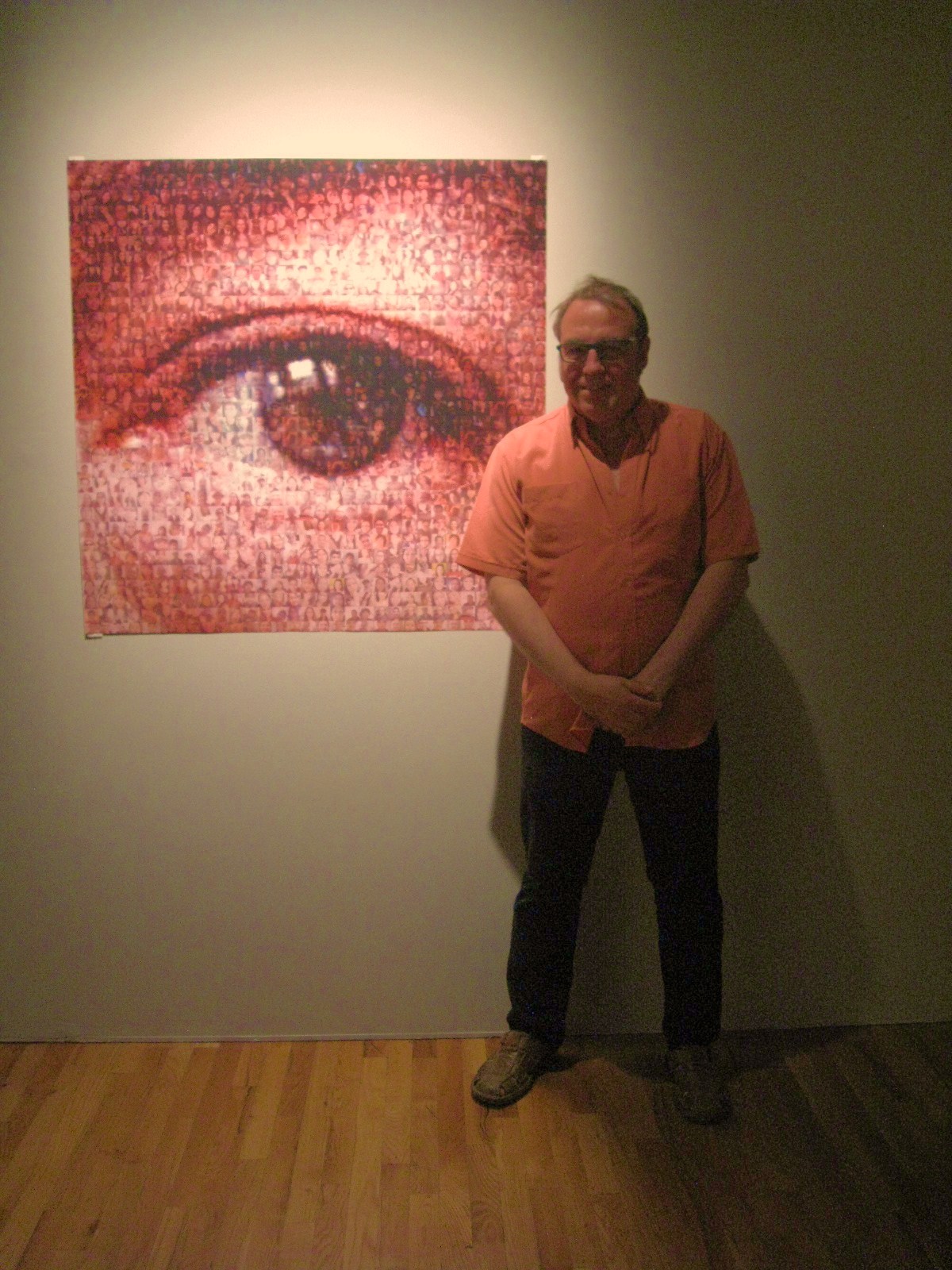
In the photo below, Michel Depatie is posing next to his work called Autoportrait. It represents not only a portrait of himself but also of a multitude of First Nation People whose images were brought together to create this very impressive digital print on paper.

Click on any image to enlarge it.

To learn more about Michel Depatie's La Traversee/Ashu-takusseu visit the Ashu-takusseu project's website:

http://ashu-takusseu.com


For more information on the Montreal First Peoples Festival, all its activities, films and dates, visit the festival's website:


Tuesday, June 09, 2015

MMFA 2015: Michael Williams - Yard Salsa

Michael Williams
Yard Salsa

June 9 - September 27, 2015

The Montreal Museum of Fine Arts (MMFA) is presenting a new exhibition in its Contemporary Art Square. It features a US emerging artist Michael Williams. It is his first exhibition in Canada.

On display are around 60 drawings and 12 paintings. Eleven paintings are located in the temporary exhibitions' hall. One additional painting, shown directly above on the left, is a promised gift to the MMFA, and it is located in the museum's permanent collection across the hallway on the same floor.


The painting above to the right, entitled Yard Salsa, had provided the name to this exhibition. Majority of Michael Williams' paintings are first composed on a computer screen, then the file is given to a printer who prints the image on a huge inkjet printer onto a pre-gessoed canvas. Some works are considered complete and finished at that point. The others, the artist airbrushes those prints and applies additional paint. This is how some acquire a doodling impression.

Michael Williams said he identified himself the most with his painting The Morning Zoo, in front of which he poses below, because it encompasses his question whether he would continue painting if he were totally spiritually satisfied. With the man's head in the painting being Buddha-like, him holding a painting brush in his right extended hand, and the classical perspective pointing straight towards the painting, one is inclined to doubt that Williams would ever give up his art, under any circumstances.


Click on any image to enlarge it.
Hover your mouse over images to see credits.


For more information, visit the MMFA website.

GUIDED TOURS 
SATURDAY AND SUNDAY, JUNE 13 TO AUGUST 30, 2015, FROM 1.30 TO 3.30 P.M., MUSEUM GUIDES WILL BE ON HAND IN THIS GALLERY TO ANSWER QUESTIONS AND DISCUSS THE EXHIBITED WORKS. 

Saturday, May 30, 2015

PAC 2015: The Aztecs

People of the Sun
The Aztecs

May 30 - October 25, 2015

Pointe-à-Callière Museum (PAC) is presenting a major international exhibition, The Aztecs, People of the Sun. Visitors have a unique opportunity to learn about the people who founded the amazing city of Tenochtitlan, capital of the Aztec Empire and the site where Mexico City was built after the Spanish Conquest in 1521. The exhibition documents at length the founding of Tenochtitlan, people's daily lives, and their everyday and ritual objects.


The exhibition also focuses on two Aztec calendars, the Templo Mayor, and also on the religious human sacrifices. It looks at many themes in Aztec's rich history: the Aztecs’ migration, guided by their god Huitzilopochtli; the founding of Tenochtitlan; the remarkable urban planning and land use development in this “Venice of Mexico”; the Aztec art of war and the tribute paid to conquerors by the conquered peoples; and their agricultural techniques and chinampas, the ingenious floating gardens that made the city self-sufficient. 


The exhibition also looks at the organization of Aztec society and its different classes. It elaborates on the role of women, education and the administration of justice. Aztec writing, the famous codices - manuscripts made up of glyphs or pictograms illustrating the spoken language - are also examined. Religion, essential and omnipresent in Aztec society, is also brought into focus, along with various deities, rituals and believes.


The exhibition was produced in collaboration with the Mexican National Council for Culture and the Arts – National Institute of Anthropology and History (INAH). It showcases some 265 items from 16 Mexican museums, including the Templo Mayor Museum, an archaeological site museum like Pointe-à-Callière itself, and the Mexican National Museum of Anthropology.
A great variety of objects is on display, both spectacular and moving. There are masks and statues, gold jewellery, figurines of women, children and animals, stamps for creating patterns on fabric and skin, chests, boxes for offerings, vases and ceramics, sculptures and objects relating to the sacrifices which it was believed were required to keep the Sun on its daily journey. They all reflect the mysteries surrounding the Aztec culture and people. 

The exhibition closes with a description of the Spanish conquest, the fall of the Aztec Empire, and the legacy of the Aztecs today. 


Click on any image to enlarge it.
Hover your mouse over images to see credits.

For more information, visit the Pac Museum website


http://www.pacmusee.qc.ca/en