Thursday, November 07, 2024

MMFA 2024: UUMMAQUTIK-ESSENCE OF LIFE

UUMMAQUTIK: ESSENCE OF LIFE

ᐆᒻᒪᖁᑎᒃ

A new presentation of the Montreal Museum of Fine Art's Inuit art collection

Starting on November 8, 2024

With this exhibition, the Montreal Museum of Fine Arts (MMFA) invites the public to experience Inuit art in newly conceived premises. Shown in brightly lit renovated and modernized galleries totalling 200 m2 on the ground floor of the Michal and Renata Hornstein Pavilion, ᐆᒻᒪᖁᑎᒃ uummaqutik: essence of life doubles the Museum's exhibition space dedicated to Inuit art.

Conceived by Inuk artist and curator Asinnajaq, this new presentation of the Museum's Inuit art collection prompts the visitors to meditate on the rhythms of life particular to the circumpolar territories known together as Inuit Nunangat (Inuit homelands in Canada). It brings together works dating from 1949 to today that demonstrate richness and diversity in contemporary Inuit artistic expression.


Prioritizing a bold storytelling approach, this evolving display will be periodically updated over the next five years, allowing the public to admire a rotation of some 120 works by 70 Inuit artists from Nunavik, Nunavut, Nunatsiavut, and the Inuvialuit Nunangat. Many of the works are being presented at the Museum for the first time.


ᐆᒻᒪᖁᑎᒃ uummaqutik: essence of life

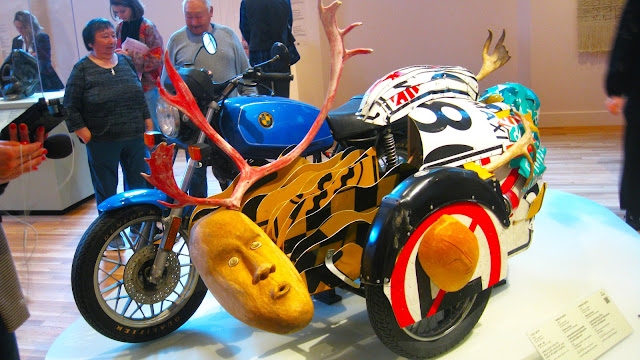
This inaugural presentation of uummaqutik comprises 60 works from the MMFA's collection – prints, drawings, textile works, photographs, paintings, sculptures and installations – by artists such as Siku Allooloo, Darcie Bernhardt, Lucassie Echalook, Charlie Alakkariallak Inukpuk, Niap, Gayle Uyagaqi Kabloona, Joe Talirunili and Jessica Winters, not to mention the eye-popping motorbike sidecar by Mattiusi Iyaituk and Etienne Guay, on loan from Avataq Cultural Institute, as well as a selection of works that are promised gifts from Lois and Daniel Miller. Later on, the space will also feature works by Kudluajuk Ashoona, Shuvinai Ashoona, Annie Pootoogook and Johnny Pootoogook, among other renowned artists.

In addition, artist Couzyn van Heuvelen has created Qulliq (2024), the MMFA's second Indigenous art commission this year. This impressive glass sculpture, whose shape and title embody the qulliq oil lamp, widely used by Inuit, is also the artist's first work to enter the Museum collection.


The energy that unites living beings and transforms our universe

Through these artforms, artists share with visitors their views on the simple and at times extraordinary moments of life, including childbirth, child rearing, everyday activities and seasonal community work. Together, the works on view portray these moments as a sharing and transmission of energy between humans and all other living beings with whom they coexist, including the plants, stones and stars.


Click on images to enlarge them.

All photos @Nadia Slejskova

This article's dedicated internet address or also click on the title above the very first photo in this article.

Visit the Montreal Museum of Fine Arts website to check on the opening hours and to purchase your tickets online.


Friday, October 25, 2024

PAC 2025: Witches


WITCHES - OUT OF THE SHADOW

October 25, 2024 - April 6, 2025

Pointe-à-Callière, Montréal’s archaeology and history complex, presents its new exhibition, an immersion into the little-known history of witches and their mysterious world. From marginalized figures, learn how these women influence popular culture and asserted their presence through the centuries. This experience of intersecting myths and reality reveals the essence of witches. 

For Halloween, the Museum is holding a special evening event, Witches’ Night Out. An out-of-the-ordinary experience in the heart of the archaeological remains, offering an immersive exploration of the exhibition and an introduction to the world of witchcraft. Thursday, October 31, 2024, from 7 pm to 1 am.


Evil, helpful, victim or rebel… the witch is a figure whose representations have evolved over the centuries and in our collective imagination. Against this backdrop, this exhibition takes visitors on a journey through 400 objects from the private and institutional collections of over 30 European and North American museums. They represent witnesses of the history of witches and their world.

Witch Hunting – A Historical Reality

In exploring the era of witch hunts in the 16th and 17th centuries, when tens of thousands of women were persecuted and executed, the exhibition takes a tangible approach to the construction of the myth of the diabolical witch: this woman responsible for illness, death, and all other manner of ills in a society in crisis. This historical immersion into Europe and North America allows to pull back the veil on the practices and trials that saw close to 100,000 women meet tragic fates, from banishment to the stake. Among the pieces on display is a copy of the Malleus Maleficarum (The Hammer of Witches), the misogynistic and ell-known treatise that played a key role in legitimizing and intensifying the practice of witch hunting.


Ancestral Know-How and Esoteric Practices

The world of witchcraft is an open window onto a broad spectrum of know-how and practices. From knowledge of medicinal plants to the art of divination, visitors are invited to explore the rituals of sorcery through a vast array of symbolic objects. Pendulums, crystals, tarot cards, and herbariums—the artifacts that reveal the powers attributed to the practices of sorcery, such as healing, enchantment, protection, and predicting the future.


Click on images to enlarge them.

All Photos @ Nadia Slejskova

For more information on the current exhibitions, activities and programs, visit the PAC Museum's website.

This article's dedicated internet address, or click on the title above the very first photo.


Monday, October 07, 2024

McCord 2024: Manasie Akpaliapik

MANASIE AKPALIAPIK: Inuit Universe

Immersion in the legends of the Far North

October 4, 2024 - March 9, 2025

The Montreal’s McCord Stewart Museum presents a new exhibition, organized and circulated by the Musée national des beaux-arts du Québec and adapted by the McCord Stewart Museum. It features the contemporary artist from Ikpiarjuk (Arctic Bay) on Baffin Island (Nunavut). It features sculptures from the remarkable Inuit art collection of the late Raymond Brousseau and offers a unique insight into the work of Manasie Akpaliapik.

Considered one of the most gifted artists of his generation, Manasie Akpaliapik uses his favourite materials – whale bone, caribou antler and stone – to create works inspired by oral tradition, cultural values, the supernatural world, as well as the wildlife and environment of the Arctic. Drawing from the mythology of the world of snow and ice in which he grew up, the artist turns to nature for inspiration and raw material, from which his unique, captivating and multidimensional works emerge spontaneously. Manasie Akpaliapik doesn’t plan what his works will look like. He combines materials and his sculptures emerge as individual and unique narratives. His fascination with whale bone - his medium of choice, though particularly rare and difficult to access - adds to the uniqueness of his works.


For five decades, Manasie Akpaliapik’s creations have been objects of fascination. Visitors will discover 40 of the artist’s sculptures at this exhibition. They tell a fragment of the story of the Inuit people and inspire reflection at a time when the relationship between humanity, nature, and climate is at the front-page. Wildlife, the tales and legends of the North of the sea goddess Talilayuq and the sacred Owl, as well as the shamanism, the transmission of knowledge and the Arctic environment are embodied in an impressive amalgam of materials that characterizes each of Manasie Akpaliapik’s creations.

Manasie Akpaliapik elaborated:

“Everything that I am doing is trying to capture some of the culture of our traditions, about simple things like hunting, wearing traditional clothing, and using legends. I feel that the only way we can preserve the culture is if people see it.”

Daniel Drouin, curator of the exhibition, stated:

“A virtuoso with hammer Manasie Akpaliapik is without doubt one of the most important sculptors of his generation. Equipped with both a masterful sense of material and technical perfection, the artist has succeeded in infusing his work with a highly personal reaction to the upheavals and transformations of his world, the Canadian Far North, and the people around him. At once humble, simple and reserved, Manasie transforms the bones found in the Arctic soil into inspiring stories. His mission: to transmit a sense of pride to succeeding generations.”


Manasie Akpaliapik grew up in Irpiarjuk on Baffin Island. In the 1980s, he migrated to southern Canada, first to Montreal, then later to the Greater Toronto Area. Although he works from his studio in the “South,” his materials come almost exclusively from the Far North. Every year he returns there since his creative process hinges on the use and combination of materials gathered from the ground in the region where he was born. The forty works presented in the exhibition, with a few exceptions, are entirely made from a combination of materials collected during his annual trips to Nunavut. As he explained:

“My art helps me preserve my connection between north and south, and thus helps me find my place between the Western world and Inuit culture.”


Art as salvation

While Manasie Akpaliapik’s work reflects Inuit history and traditions, it also touches on his own personal story with a profoundly human and universal sensitivity. Art becomes a means of expressing the challenges he has had to overcome, but also of externalizing the demons he has long battled. In his own words: 

“When life gets really tough, my art is always there to pull me up."

His exceptional work demonstrates the influence of contemporary art and culture.

Anne Eschapasse, McCord Stewart Museum President and CEO stated:

“As the custodians of a collection that bears witness to nearly 12,000 years of Indigenous history and presence on the land, the McCord Stewart Museum has long worked to highlight the vitality and diversity of contemporary Inuit, First Nations and Métis artists. Thanks to our collaboration with the Musée national des beaux-arts duQuébec, we are delighted to be able to present the work of Manasie Akpaliapik, who is unquestionably one of the greats of his generation.”


Manasie Akpaliapik

With a career spanning four decades and his art displayed in institutions such as the National Gallery of Canada, the Museum of Civilization, and several private galleries, Manasie has created art inspired by his deep love for animals and for Inuit legends and their narratives in which the relationship between humans and animals is one of mutual respect.

Manasie is also a practised drum dancer, drum maker and is versed in kayak building. He continues to travel to the Arctic every year to search the shores for ancient whale bones and to connect with his family and community. He enjoys passing the Inuit legends to the younger generation and works tirelessly to keep the oral tradition of storytelling alive.

Click on images to enlarge them.

All photos @ Nadia Slejskova

For more information about current exhibitions and special evens associated with this exhibition, visit the McCord Stewart Museum website.


For this article's dedicated internet address click on the title above the very first image or here.


Monday, September 23, 2024

Centaur Theatre 2025: Sakura

Centaur Theatre / 56th Season
SAKURA – After Chekhov

Written by Harry Standjofski

Directed by Eda Holmes

With Deena Aziz, Ravyn R. Bekh, Stefanie Buxton, Marcel Jeannin, Marc-Antoine Kelertas, Howard Rosenstein, and Paul Van Dyck

September 17, 2024 — October 6, 2024

This is a world premiere adaptation of a 19th century Russian play, based on Anton Chekhov’s masterpiece The Cherry Orchard, a story of a pre-revolutionary Russian upper-class (gentry) family forced to sell their estate, including a beloved orchard, to pay off debts that have accumulated from years of mismanagement and self-indulgence. Yet if one cherishes the original Chekhov's plays, the subtle and even elusive way he portrays his characters, their dilemmas and relationships, as well as the general mood and wider social connotations, the Harry Standjofski's reinterpretation of the play for the 21th century is very different. Although he uses the same though renamed characters as in the Chekov's play, with basically the same plot, his play fails to create a deep sympathy for the personages on stage as do the original Chekov's plays.

Moreover, the Standjofski's play is supposed to be a "witty comedy with a hint of nostalgia". Chekov's play was not a comedy. This is where the plays of two playwriters part. The frequent language crudity and the enactment on stage of the sex act bring both plays even further apart.

Harry Standjofski is a Montreal playwright and actor. His play is based on the present day's milieu that surrounds him and that he knows the best: their current sensibilities, the language usage, their relationships, and how they tend to express their frustrations and desires. A great number of the audience could relate to that and even identify with it. However, those who might hope to see a Chekov-type of play might be disappointed.


All images in this article courtesy of Centaur Theatre.

For more information about Centaur Theatre visit the Centaur Theatre website.


Sunday, September 15, 2024

MMFA2024: TWO BY TWO, TOGETHER

TWO BY TWO, TOGETHER

Bringing together over 80 recent additions to the MMFA's collection

September 11, 2024 – October 5, 2025

With this exhibition, the Montreal Museum of Fine Arts (MMFA) is opening a window into its collecting practices. Two by Two, Together, which brings together a rich selection of works from all over the world that have been acquired over the past five years. Most of them are being shown to the public for the first time and are grouped together in such a way as to create a dialogue between them, while showcasing the Museum's many collecting areas of interest.

Two by Two, Together unveils some 80 diverse works that shine a spotlight on works made in a wide range of artistic disciplines by artists from Quebec, Canada, and around the world. Visitors can admire important paintings by Peter Doig, Pierre Dorion, Wanda Koop, Stéphane La Rue, Robert Clow Todd, Claude Tousignant, Robin F. Williams and Lawrence Paul Yuxweluptun; sculptures by Louise Bourgeois, Stanley Février, Giuseppe Penone and Kishio Suga; graphic works by Tony Lewis, Nicolas Party and Rembrandt; photographs by Herbert List and Robert Mapplethorpe; and an early Chinese cosmic board (Liuren Shipan) from the Sui Dynasty.

The MMFA's permanent collection is one of the oldest in Canada and consists of close to 47,000 art works and objects from five continents, dating from the Neolithic era to the present day. This collection grows each year through donations, purchases and bequests.

Stéphane Aquin, Director of the MMFA, stated:

"In continuously developing the collection, the MMFA is committed to presenting works by artists who have long been marginalized and underrepresented. We aim to offer our audiences an increasingly inclusive experience, through the diversity and richness of acquisitions from every corner of the globe and spanning thousands of years of history."

Iris Amizlev, Curator of Special Projects at the MMFA and curator of the exhibition added:

"Most of the works in Two by Two, Together are grouped together, such as to create a dialogue between them based on their subject, medium, form, function or period. Through these juxtapositions, we hope to provoke new and enlightening interpretations of the Museum's collection." 

Aside from the creations shown in the exhibition, other recently acquired artworks can be found in the Museum's permanent collection galleries, identified by special labels. In addition, a new rotation of works in the galleries adjacent to Two by Two, Together highlight new contemporary acquisitions by such artists as Esmaa Mohamoud, Christina Quarles and Kareem-Anthony Ferreira.

The acquisition process

Every potential acquisition is subject to the same rigorous process in order to evaluate whether it is a pertinent addition to the MMFA's collection.

The curatorial team conducts extensive research to determine if the object will enhance the MMFA's collections, either by adding depth to or diversifying it, or by introducing new perspectives.

Works are also evaluated by the Conservation department to assess their condition. Factors such as instability, damage or inadequate restoration attempts might influence acquisition decisions.

If the results of these investigations support an artwork's inclusion in the Museum's collection, curators present their acquisition recommendation to internal and external acquisition committees. Each of the four acquisition committees includes at least one member of the MMFA's Board of Trustees as well as external advisors. If committee members agree with the recommendation, and this recommendation is approved by the Board of Trustees, the acquisition can proceed. The work is then catalogued, photographed and restored, as necessary.

Credits and curatorial team

An exhibition organized by the Montreal Museum of Fine Arts.
It is curated by Iris Amizlev, Curator of Special Projects, MMFA

Visit the Montreal Museum of Fine Arts website to check on the opening hours and to purchase your tickets online.


Saturday, September 14, 2024

McCord 2024: Michaëlle Sergile

Michaëlle Sergile:

To All the Unnamed Women

Exploring the relationship between history and archival violence

September 13, 2024 - January 12, 2025


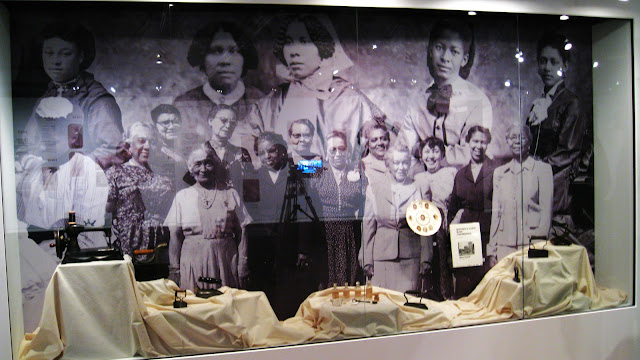
This exhibition is presented by the Montreal's McCord Stewart Museum. It combines archival records and fiction, and traces the origins of the first collective created by Black women in Quebec, the Coloured Women’s Club of Montreal (CWCM). Michaëlle Sergile is drawing on the concept of critical fabulation theorized by an American author Saidiya Hartman, defined as a methodology that combines historical and archival research with a critical theory and fictional narrative (see here).


For her first solo exhibition at the museum, the artist has created 7 original tapestries on Jacquard looms. Three of them reconstruct images selected from the Museum’s Photography collection, and four illustrate portraits of CWCM members. Archival photographs and objects from the Museum collections complete the installation. The artist stated:

 “When I started working with textiles, I realized there was a disconnect between the visual arts and craft, as if the two notions couldn’t coexist. I thought it fitted in very well with the way I conceptualized archives, because I was very interested in anything that’s put aside. I felt that the medium of weaving itself was being sidelined. I liked that the word métissage (“racial mix”) contains tissage (“weaving”), just like text and textile.”


For Michaëlle Sergile, creation is a way of confronting the limitations of archives, of imagining and fully recognizing the lives of individuals of whom we have only a few traces. Weaving was an obvious choice as a medium for expressing the realities of the Black women featured in the exhibition, as many parallels can be drawn between the themes addressed and weaving. Often associated with handicrafts, this medium is still rarely used by artists. As proof, only 3 computer-assisted Jacquard looms – used by Michaëlle to create her works – are available in Montreal.


Michaëlle Sergile stated about her installation:

 “To All the Unnamed Women doesn’t simply commemorate the past, but offers a profound reflection on the creation of memories and the importance of identification. Through archives, I can say what I can’t always say. It’s a great way to create a link with people who once existed but are no longer with us today, to give a sense of continuity to their discourse. I think there’s something beautiful and powerful about thinking of all the people who have had these thoughts before you, and being able to associate them with the period you’re living in.” 


Michaëlle Sergile

Michaëlle Sergile is an independent artist and curator working mainly with archives from the post-colonial period, from 1950 to the present day. Her artistic practice aims to understand and rewrite the history of Black communities, and more specifically that of women, through the medium of weaving. Traditionally associated with craftsmanship and femininity, weaving allows her to explorepower relations linked to gender and ethnicity

She has recently exhibited her work at the Musée national des beaux-arts duQuébec, the Musée d’art deJoliette, the Fonderie Darling and the OFF, Biennale deDakar, Senegal. She also waslong listed for the prestigious Sobey Arts Award in 2022. In 2023, she won the Visual Artist of the Year Award at Gala Dynastie and began a residency at the Fonderie Darling.

Curatorial and production team:

An exhibition created by the McCord Stewart Museum.

Artist: Michaëlle Sergile

Project management: Caroline Truchon

Project Manager, Exhibitions Curating: Mathieu Lapointe

Curator, Archives Graphic design: David Martin


Click on images to enlarge them.

All photos @ Nadia Slejskova

For more information about current exhibitions and special evens associated with this exhibition, visit the McCord Stewart Museum website.