Friday, June 01, 2018

MAC 2018: Rafael Lozano-Hemmer


RAFAEL LOZANO-HEMMER
UNSTABLE PRESENCE

May 24 - September 9, 2018, 

The Musée d’art contemporain de Montréal (MAC) is hosting an exhibition by the Montreal-based and internationally-acclaimed artist Rafael Lozano-Hemmer. It is his largest solo show in Canada or the United States. It provides an unusual and a unique museum experience where the visitor participation and interaction with the exhibited pieces is necessary for the full functionality of the art work. Those participating will in effect become a part of the works since they are needed to reveal the installations' underlying central concept.

Unstable Presence is a major survey of Lozano-Hemmer’s work over the past 18 years. It brings together 21 pieces, including several large-scale immersive installations. In his work, Lozano-Hemmer draws on science, technology, politics, sociology, poetry, music and art history, while engaging the public in a conversation


Born in Mexico, Rafael Lozano-Hemmer, as a conceptual artist, is a leading international figure in participatory and digital-media practices. He is known on the art world stage where his work is regularly shown in the most prestigious institutions. During the 1990s, he began exploring the performance and interaction potential of his works, in particular, the merging of various artistic disciplines with technology, which he described as the language of our time, basic and inevitable.

The participatory and technological aspects of Lozano-Hemmer’s works are based on co-presence, where live and recorded data overlap. Through the use of microphones, face-recognition algorithms, biometric scanners and computerized surveillance, artworks interact with the visitors in performances that could be perceived as both playful and intimate, but where the technology underlying the interaction often echoes more troubling social, economic and political dynamics.


Showing how we interact with technology and making the internal mechanisms of devices visible is one of the strategies deployed in Lozano-Hemmer’s works. As one walks through the exhibition, the physical presence of the works and their sculptural occupation of space, makes the invisible digital world on which they are based quite factually present. This concept overpowers the visitors right in the Museum's entry hall, where the impressive Pulse Spiral (2008), is displayed. 300 light bulbs and kilometres of electrical wire are configured to reproduce, through light, the beating hearts of the Museum’s visitors. The evanescent spiral of lights swill betrays the fascination with seeing one’s heartbeat, and the way it eventually merges with the recordings of the previous 299 participants.


For music lovers, there is Sphere Packing: Bach (2018, a new work by the artist presented for the very first time), and Sphere Packing: Wagner (2013). These installations are two in a series of 17 works that concentrate the entire musical production of a composer into a single multi-channel sphere. The black-glazed porcelain sphere dedicated to Richard Wagner (13 centimetres comprising 110 channels of sound) hangs from the ceiling and visitors have to bring their ear up close in order to hear the individual compositions. The far more prolific composer, Johann Sebastian Bach, required 1,128 individual speakers distributed through a 3-metre sphere that visitors may physically enter and thus immerse themselves in the totality of the Baroque composer’s opuses, played simultaneously.


In Call on Water (2016), the writings of celebrated Mexican poet Octavio Paz, who was the artist’s uncle, are presented in a fountain that acts as a poetry machine. The water is turned into cold vapour by ultrasonic atomizers, which project the words into the air above the basin for a few compelling instants. Contemplative and poetic, the work highlights the materiality of language and converts it, as the poet would probably have appreciated, into a breathable atmosphere.


In a whole different register, one which engages with power relations and surveillance equipment, Zoom Pavilion (2015), made in collaboration with Polish artist Krzysztof Wodizcko, is a room-sized interactive installation where participants are surrounded by projected black-and-white images of faces and bodies localized within the space. Twelve computerized surveillance cameras track the presence of participants and, employing facial recognition combined with background subtraction and machine-learning algorithms, record their spatial relationships to one another. The piece makes evident the omnipresence of surveillance cameras, but what is at stake is the tracking of public assembly, and keeping an archive of how long and how far each visitor was from each other.


Vicious Circular Breathing (2013),  is a large sculptural installation evoking both a curious scientific device and a gigantic musical wind instrument, similar to an organ. It consists of brown paper bags that inflate and deflate at human breathing rates, a set of motorized bellows and valves that control the bags, and a sealed glass room with a decompression chamber. Visitors are invited to enter the glass chamber to breathe the air that was previously breathed by earlier participants. Despite its amusing musical allusions, the piece is disturbing and uncomfortable: it includes warnings regarding the risks of asphyxiation, contagion and panic. Among other interpretations, the piece is a statement on the limits of the planet’s resources but also a commentary on the supposedly empowering culture of participation, — in this piece your participation makes the air more toxic for future visitors.


Rafael Lozano-Hemmer is a recipient of the 2015 Governor General's Awards for Visual and Media Arts. In June 2016, he was named a Companion of the Ordre des arts et des lettres du Québec by the Conseil des arts et des lettres du Québec.


Click on images to enlarge them.
Hover your mouse over images for description and credits.

For more information about MAC, visit the museum's website.

Tuesday, May 22, 2018

McCord 2018: Marisa Portolese


IN THE STUDIO WITH NOTMAN
AN EXHIBITION OF ARTIST IN RESIDENCE MARISA PORTOLESE

May 25, 2018 - February 10, 2019

This exhibition consists of 16 large-scale colour portraits of women taken with an analog view camera using natural light. It is the result of Portolese's research on the McCord Museum's Notman collection as a McCord's Artist in Residence.


For years, Portolese has been preoccupied with taking photos of women she knew personally, always from the perspective of their female-feminist power. Additionally, she embarked on studying the decors of traditional studio photography, such as in Notman's portraits. Like Notman, she also photographs children, mothers and older women, and uses backdrops and props to showcase her subjects within a confined space. In her compositions, the decor chosen for a specific portrait has a primary aesthetic function and a specific personality. 


Inspired by the sets created by Notman, Marisa Portolese chooses decors that evoke the Victorian era, yet her portraits, rich colours, and the vitality of the floral motifs, represent her personal choices. She roots her photographic portraiture in a pictorial tradition borrowed from art history.


The backdrops in Portolese's works, especially the floral arrangements, are spectacular. They are taken from paintings of old Dutch masters. She found the photos of these paintings in the public domain on the internet, cropped out images and floral arrangements she liked, enlarged and printed them, than hanged them in her studio behind a sitter. Though the resulting photos are spectacular, and the photographs of old master can be freely found on the internet, a question still remains of legitimacy of using bits and pieces from other people's creations for one's own works. It is well known that photographers themselves do not like when their photos are cropped or edited, or even worse, when some elements are appropriated out of them, and out of the original context, and then implanted by others into their personal works.


The exhibition is accompanied by a bilingual publication, Marisa Portolese – In the Studio with Notman / Dans le studio avec Notman, published by the McCord Museum with the financial assistance of Concordia University’s Faculty of Fine Arts and the Gail and Stephen A. Jarislowsky Institute for Studies in Canadian Art. This book explains the artist’s approach, what inspired her portraits and the decors chosen specifically for each model, and points to similarities between women from different eras.

It is a pity the source of backdrop imagery in each photo is not acknowledged in Portolese's exhibited works at the McCord Museum and, with an exception of very few, in her book. By cropping those images from photos of old paintings, most likely enhancing them to her purposes on a computer, then enlarging them, still does not make them to be her own creations, regardless of an erroneous understanding a viewer of her portraits might get. 

Marisa Portolese at her McCord Museum Exibition

About Marisa Portolese

Born in 1969, Marisa Portolese is a Montreal artist of Italian descent. A graduate of Concordia University's MFA program in 2001, she is now an Associate Professor of Photography in the Faculty of Fine Arts. Her practice includes photography, video and curatorial work.

Portraiture, representations of women, narrative, autobiography and the figure in nature are major and recurrent subjects in her work. She often produces large-scale colour photographs rich in painterly references, which focus on facets of human experience in psychological and physical environments, creating immersive landscapes for the viewers.

Since 2002, Portolese has produced a number of photographic projects for exhibitions or publication: Belle de Jour I, II, III (2002-2016), Un chevreuil à la fenêtre de ma chambre (2003), The Recognitions (2004-2005), The Dandy Collection (2008), Imagined Paradise (2010), and Antonia's Garden (2011). She is the recipient of several awards along with numerous grants from the Canada and Québec Arts Councils, and the Du Maurier Arts Foundation.


Click on images to enlarge them.
All photos in this article by Nadia Slejskova.

For more information, visit the McCord Museum website.

Saturday, May 19, 2018

PAC 2018: Queens of Egypt

Majestic Queens of Egypt
North American premiere
April 10 - November 4, 2018

This exhibition, produced by the Montreal’s Pointe-à-Callière museum of Archaeology and History (PAC) in partnership with Turin's Museo Egizio, unveils the splendour and mystery of Ancient Egypt and illustrates the importance of queens in Egypt's New Kingdom period. It gives visitors a rare opportunity to fully comprehend the grandeur of Egyptian civilization and especially power its women exercised during the New Kingdom period. The exhibition portrays the world of the Great Royal wives, sisters, and daughters of the pharaohs. It presents the Queens and illustrates the diverse and important roles they played in Egyptian society. Their lives are revealed in an immersive exhibits tour that features over 350 rare, precious, and symbolic objects.


Francine Lelièvre, the Pointe-à-Callière museum's executive director stated:
"Throughout history, women's stories have so often been obscured, but these Egyptian women of power played an important role in society. I hope that the tribute we pay to the queens of Egypt in this exhibition, and the exceptional quality of the objects presented, will remind visitors of how instrumental this society's contributions were. Ancient Egypt gave us ingenious irrigation canals; master artisans; incredible architecture in their temples, palaces, and villages; elegance in body care; and strong, intelligent women of power who had a great appreciation for beauty and meaning. We have so much to learn from their immense legacy."

Nile’s Right (east) Bank – The World of the Living

The first part of the exhibition shows settings frequented or inhabited by pharaoh and his queens during the New Kingdom period, some 3,500 years ago. According to the ancient Egyptian’s myth, the right bank of the Nile was the world of the living, with such landmarks as the city of Thebes, the imposing temples of Karnak, and Luxor. PAC presents the temple of the mythological war goddess Sekhmet, reveals the rules of life in the pharaoh and queen palace, and reveals the elegance and splendour of a harem.


The harem: for women only

The exhibition also portrays an Egyptian harem, a royal institution reserved exclusively for women and children, where the queen, noblewomen, and the pharaoh's concubines ruled and men entered only to serve them. One of the displays also ofers a chance to experience perfumes and beauty objects in Nefertiti's harem. The harem was a place of beauty, culture and education, but also a place to hatch a plot. The harem conspiracy papyrus, dating back 3,200 years, reveals secrets of a harem’s captivating world and tells the story of an elaborate plan by one of Ramesses III's wives, Tiye, to murder him.


Nile’s Left (west) Bank – The World of the Dead

In the exhibition’s second section, visitors travel to the world of the dead - the Theban necropolises on the Nile's west bank. They visit the village of Deir el-Medina, where artisans spent their lives building the royal tombs and objects to accompany the deceased in the afterlife. There are tools, everyday objects, and vases, along with other objects that reveal the reverence this village held for Queen Ahmose-Nefertari. There are also writing tools of scribes, papyruses, and a video explains about the Egyptian letters and how to read those ancient texts.


Voyage to the Valley of the Queens

The exhibition's final section is set deep in the Valley of the Queens. It featurs items from the royal tomb of Ramesses II's favourite wife Nefertari, and recreats the ambiance of the actual tomb discovered in 1904 by Ernesto Schiaparelli, former director of Turin's Museo Egizio.


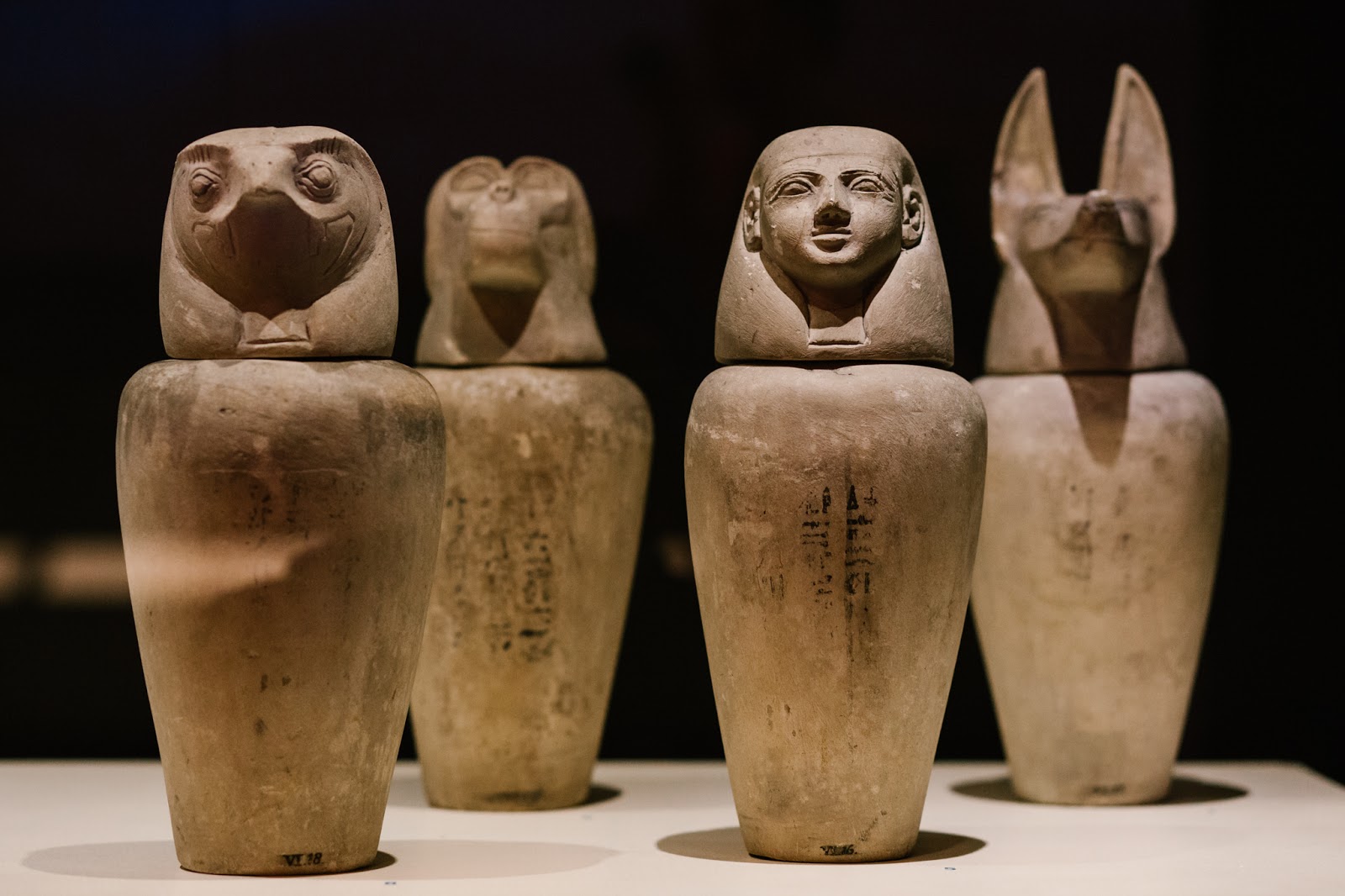
The display reveals Ancient Egypt's burial rituals: tools and materials needed to transform the body, a hook, flint knife, and resin, funerary jars, and a papyrus excerpt of The Book of the Dead that illustrate the ritual of mummification. A mummy, resting on a transparent surface, forms the heart of this installation with magical amulets woven into the linen strips to protect the deceased. This section also features objects that accompany the deceased in the afterlife: amulets, canopic jars, and shabtis. There are also a dozen painted coffins that additionally demonstrate the ritual funerary practices and their role in achieving eternal life.


The final part of the exhibition presents the funerary chamber of Queen Nefertari and her granite coffin, shattered by looters. Yet looters left behind many lesser valued objects (but highly valued by archaeologists), and some of these items are among the exhibition's most rare artefacts.


Ubisoft: using technology to teach history

To give visitors a complete immersive experience, Pointe-à-Callière partnered with Ubisoft Montréal and the team of Assassin's Creed Origins, the most recent edition of this video game franchise, which takes place in Ancient Egypt. Exclusive and custom-tailored videos and soundtracks from the game's Discovery Tour enhance the exhibition: scenes from the sumptuous palace, seat of the pharaoh's power, the western desert, the houses, streets, artisans, village life, or the daily lives of women of power, these carefully crafted visual portrayals of ancient life in Egypt are also highly informative about the themes developed in Queens of Egypt exhibition, such as the mummification ritual, the work of scribes, and the writing of hieroglyphs.


Click on images to enlarge them.
Hover your mouse over images for description and credits.

For more information on the current exhibitions, activities and programs, visit the PAC Museum's website.

Monday, May 14, 2018

MMFA 2018: Picasso


FROM AFRICA TO THE AMERICAS
FACE-TO-FACE PICASSO, PAST AND PRESENT

May 12 – September 16, 2018

There are 3 elements to this exhibition: the works of Picasso, the art works that originated mainly on the African continent but also Oceania and the Americas and had influenced Picasso's artistic expression, and also Black Canadian contemporary art.

It is an adaptation of an exhibition originally mounted by the Musée du quai Branly-Jacques Chirac in partnership with Musée national Picasso-Paris. The MMFA has adapted and expanded on that exhibition launched in 2017 by the Musée du quai Branly-Jacques Chirac, a co-production with the Musée national Picasso-Paris. The initial exhibition, as conceived by Yves Le Fur, Director of the Department of Heritage and Collections, Musée du quai Branly – Jacques Chirac, invited a dialogue between “the works of Picasso – not only the major works but also the experiments with aesthetic concepts – with those, no less rich, by non-Western artists."


The exhibition brings together some 300 works and documents, mainly from the Musée du quai Branly-Jacques Chirac and the Musée national Picasso-Paris. To this, the Montreal Museum of Fine Arts (MMFA) has added works from its own collection, as well as loans from the Art Gallery of Ontario and from private collections and galleries in Belgium, Switzerland, France, Italy, England, the USA, South Africa and Canada.


The exhibition features almost a hundred works by Picasso – paintings, sculptures, ceramics and works on paper – which attest to the important influence of Africa and Oceania art. Seventy of them come on loan from the Musée national Picasso-Paris. Numerous others are being loaned to the MMFA by the Picasso family and the Fundación Almine y Bernard Ruiz-Picasso. A huge collection of documents, letters, objects and photographs, together with 27 works from the artist’s personal collection, testifying how these arts accompanied Picasso throughout his life.


The exhibition reveals aspects of the material and spiritual cultures of traditional societies, African in particular, by presenting numerous works, mostly from Africa and Oceania, dating from the late-19th and early-20th century, together with a number of early Iberian and pre-Columbian works.


There are some 70 artworks from the collection of the Musée du quai Branly – Jacques Chirac, notably an anthropomorphic Dan mask from Côte d’Ivoire, a Songye mask from the Democratic Republic of the Congo, a Bahinemo hook figure and a Baining mask from Papua New Guinea, a large grade figure from Vanuatu, an Inuit mask from Greenland and an incised Taino anthropomorphic axe blade from the Lesser Antilles that once belonged to André Breton. Other pieces came from the Picasso’s family and the Musée national Picasso-Paris, including a majestic Baga shoulder mask from Guinea.


The MMFA addied several leading artists from the contemporary art scene – mainly African or of African descent: Omar Ba, Edson Chagas, Omar Victor Diop, Samuel Fosso, Romuald Hazoumè, Nicholas Hlobo, Masimba Hwati, Moridja Kitenge Banza, Zina Saro-Wiwa, Zanele Muholi, Pedro Pires, Yinka Shonibare MBE, Mickalene Thomas and Kehinde Wiley. Several of these works were acquired or are in course of acquisition by the MMFA.


At the beginning and end of the presentation, two video installations are being shown for the first time in North America: representing South Africa at the Venice Biennale in 2017, Mohau Modisakeng presents Passage while Theo Eshetu presents his video installation Atlas Fractured, first shown at Documenta 14 in 2017. The exhibition also incorporates some loans from McGill University’s Redpath Museum and from Guy Laliberté’s Lune rouge collection, as well as a number of pieces from the Marquesas Islands and New Zealand from MMFA’s collection.


Click on images to enlarge them.
All photos by Nadia Slejskova.

The exhibition is located at the The Montreal Museum of Fine Arts' Jean-Noël Desmarais Pavilion – Level 3.


For an additional information about the Montreal Museum of Fine Arts exhibitions and activities, visit the museum's website.


Saturday, May 05, 2018

McCord 2018: Shalom Montreal


Exhibition Poster, © McCord Museum
Visuel de l’exposition, © Musée McCord

SHALOM MONTREAL
STORIES AND CONTRIBUTIONS OF THE JEWISH COMMUNITY

May 3 - November 11, 2018

The McCord Museum's new exhibition highlights how the Jewish community has participated in the Montreal's growth and development during the 20th century. It features the achievements in a variety of sectors such as architecture, heritage preservation, health and science, human rights, business, the arts and culture, that all have benefited, and continue to benefit, all the inhabitance of the city. Featuring personal reminiscences, videos and photos, the exhibition invites visitors to discover the stories behind many major contributions to the city.

The word Shalom symbolizes openness to others and friendship. The history of Montreal’s Jewish community reflects the strength of its traditions and centuries-old roots. Nourished by a fertile cultural and intellectual climate, its many significant achievements attest to a desire to work together and help one another.


Anonymous, Moe Wilensky and customers, Montreal, 1965. Courtesy of the Wilensky family

Visitors are welcomed to the exhibition by a testimonial from Elaine Kalman Naves, a Jewish writer and journalist who recounts her arrival in Montreal and her life here.

The exhibition features multiple multimedia installations, organized into five different thematic zones.

David De Stefano, Dipping bagels in sesame seeds, St-Viateur Bagel, Montreal, 2012. Courtesy of St-Viateur Bagel

The next zone, entitled Exoduses, describes the various waves of Jewish immigrants to Montreal over the 20th century, against a backdrop of national revolutions and global conflict. It also looks at the anti-Semetism that the Montreal Jewish community suffered for many decades in the 20th century.

The third zone, Memories, gathers together meaningful objects that belonged or still belong to Jewish immigrants, artefacts that have accompanied them throughout their journey. Part of a Torah scroll (late 19th century), a tablecloth made by 50 young orphans (1920-1927), and a doll named Toniška (about 1941) are among the items on display.


Living Together, the fourth zone, highlights the contributions of Jews to the Montreal community. The heart of the exhibition, this area explores how the Jewish and Montreal communities have learned to build, care, struggle, do business, and create together.


© Marilyn Aitken, McCord Museum
Montreal Holocaust Museum, photo: Peter Berra

Building Together
Jewish architects have distinguished themselves in Montreal, whether by designing buildings that have become important symbols of the city, preserving our urban heritage, or participating in various real-estate developments. Furthermore, thanks to Jewish philanthropy, the urban landscape throughout the city has been enriched by numerous buildings, particularly on university campuses and in the fields of medicine and culture. Many drawings and a scale model illustrate this first sub-zone.

Caring Together
Montreal Jews have often faced discriminatory practices, which prompted them to establish their own institutions. However, Jewish organizations have never responded in kind, and instead have long been in the forefront of the movement for universal access to health care. The creation of the Jewish General Hospital of Montreal is a perfect example of this. In the field of basic research, Jewish scientists like Dr. Mark Wainberg and Dr. Ronald Melzack have made significant contributions, particularly since the 1960s. This sub-zone offers a number of testimonials.

Struggling Together
Many Jews seem especially motivated to take part in social struggles for fairness, justice and human rights. Some attribute their passionate commitment to such causes to the fact that they have faced anti-Semitism, others cite Jewish religious teachings, while yet others mention the revolutionary heritage of Russian immigrants. Whatever their motivations, they have left their mark on 20th-century Montreal with their decisive contributions to universal social movements such as women’s liberation, workers’ rights, and the fight against racism and exclusion. Among the objects presented are a community newspaper and election posters.

Doing Business Together
The Jewish community has played a significant role in Montreal's economy. Some entrepreneurs in particular have created hugely successful commercial ventures. Often, small shops have developed into major business empires or become internationally known symbols of Montreal. Some of these businesses have left a mark on the culture of the city, and even of the province. Among the objects displayed are articles of clothing created by well-known brands like Le Château, Parachute and Canadelle, along with iconic artefacts like a Steinberg's grocery bag.

Creating Together
The final sub-zone focusses on three fields in particular—music, the visual arts and literature—to convey the incredible vitality of the Jewish artists who have lived in Montreal. Visitors can see books by Irving Layton, a gramophone (1902-1925) designed by Émile Berliner, Mordecai Richler's typewriter, and paintings of Montreal done by the mid-20th century artists collectively known as "Jewish Painters of Montreal" (Neumann, Muhlstock, Beder, Mayerovitch and Reinblatt).

Duncan Cameron, Women on steps holding signs “No Nuclear Arms for Canada / Pas d’armes nucléaires pour le Canada,” Montreal, 1961. Library and Archives Canada, PA-209888

Anonymous, Nurses tending to newborns in neonatal ward, Jewish General Hospital, Montreal, about 1960s. Courtesy of the Jewish General Hospital Historical Archives, ID 1-18.9.3.4

The exhibition concludes with a documentary-style multimedia installation in which 14 young Montreal Jews discuss their views of the city, their contributions to the community, and what it means to be Jewish in Montreal in 2018.


David Bier, Sephardic refugees arriving at Dorval Airport (now Pierre Elliott Trudeau International Airport), Montreal, 1974. Alex Dworkin Canadian Jewish Archives

Click on images to enlarge them.
For more information, visit the McCord Museum website.